
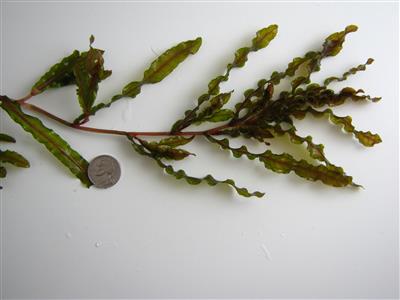
Curly-leaf Pondweed
(Potamogeton crispus)
Species at a Glance
Curly-Leaf Pondweed is an invasive aquatic perennial plant that can grow offshore in depths of up to 15 ft (4.5 m). It has the unique ability to form new plants under the ice in the winter, making it one of the first nuisance plants to emerge in the spring. Curly-Leaf Pondweed was introduced to the United States by hobbyists who used it as an aquarium plant, and it has since been reported in almost all of the continental United States.
Species Description
This submersed aquatic plant has oblong, slightly stiff, and crinkled leaves that alternate along a thin stem. The leaf edges are wavy and finely toothed, resembling small lasagna noodles.
Leaves are usually 4-10 cm (1.4-4 in) long, and color can range from blue-green, to olive-green, to reddish-brown. Small flowers, produced from June through September, are tightly arranged in spikes a few inches above the water’s surface. In the spring, the plant produces dormant overwintering buds called turions, which look like small greenish-brown pinecones.
Native & Introduced Ranges
Native to Eurasia, Africa, and Australia, Curly-Leaf Pondweed was introduced to the United States during the mid-1800s by hobbyists who used it as an aquarium plant. It has since been reported in almost all of the continental United States and is widespread throughout Pennsylvania.
Biology & Spread
Spread most likely occurs as rhizomes, turions, and plant fragments are moved around by boats, trailers, personal watercraft, fishing equipment, and natural water movement. Plants die in July, and turions drop to the sediment where they can remain viable for years until conditions are right and cooling water temperatures trigger their germination.
Unlike other plants, Curly-Leaf Pondweed actively grows during winter months when most plants are dormant, giving it a competitive advantage. In addition, while not the main method of reproduction, plants also spread by the movement of seeds, which can pass through the digestive systems of waterfowl unharmed and be distributed to new areas.
Habitat
A strong rhizome anchoring system allows Curly-Leaf Pondweed to grow in a variety of locations and sediment types. It can tolerate extreme conditions including low light, polluted, disturbed, or turbid waters where many native plants cannot survive. It can also tolerate cold water temperatures and has even been found growing under several inches of snow-covered ice.
Impacts
Threat to Biodiversity
While Curly-Leaf Pondweed does provide habitat for aquatic life in the winter months, excessive growth in the spring leads to dense mats that displace native vegetation and impact the ecological stability of the water body. Mid-summer die-offs can also lead to depleted oxygen conditions, mats of plant material washing up on beaches, and an increase in nutrients that can cause harmful algal blooms.
Economic Costs
Dense mats of Curly-Leaf Pondweed can impede recreational activities such as boating, fishing, swimming, and water skiing. Property values may also decrease around lakes heavily infested with the plant.
Prevention & Control
Once Curly-Leaf Pondweed becomes established in a waterway, eradication can be a difficult and expensive commitment. Therefore, preventing the introduction and spread of Curly-Leaf Pondweed is the best way to protect natural habitats from harm.
- Know how to identify and report Curly-Leaf Pondweed.
- Always check for and remove plants, mud, and debris from boats, trailers, clothing, and equipment before entering a water body and before leaving a water body.
- Drain all water from bait buckets, bilges, and live wells before transporting to new areas.
- Clean all gear and equipment with hot water (140°F or 40°C) or salt water, OR let boats and equipment dry thoroughly for at least five days before entering a new water body.
- When choosing plants for a pond or water garden, purchase from a licensed nursery and choose regionally native or non-invasive plants. Check with your state natural resource agency to confirm which plants to avoid for your region.
References:
- Minnesota Department of Natural Resources. 2005. Invasive, non-native species: curly-leaf pondweeds (Potamogeton crispus). Factsheet
- Indiana Department of Natural Resources. 2009. Curly-leaf pondweed. Aquatic Invasive Species files.
- Iowa Department of Natural Resources. Curly-Leaf Pondweed factsheet.