
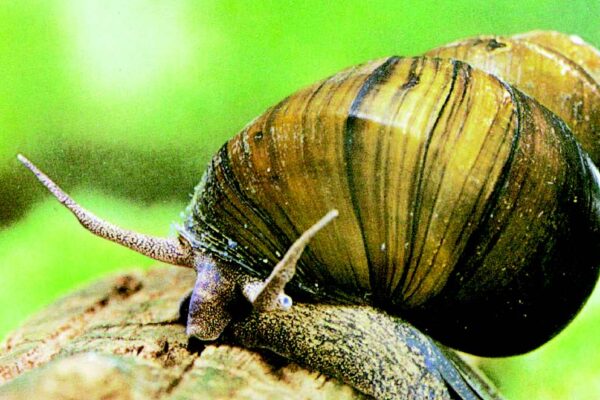
Mystery Snails
(Cipangopaludina chinensis and Heterogen japonica)
Species at Glance
Mystery Snails are large freshwater snails commonly sold for use in freshwater aquariums and garden ponds. The term “mystery snail” refers to both the Chinese Mystery Snail and the Japanese Mystery Snail, which were previously thought to be the same species. Mystery Snails are popular in the aquarium, ornamental, and live food markets, contributing to high rates of release and spread across the United States.
Species Description
Both species of Mystery Snail have large, smooth, globose shells that range from light to olive green or brown that tend to darken as they age. The Chinese Mystery Snail typically grows 25-38 mm (1-1.5 in) but can reach up to 64 mm, with 6-7 whorls, a small umbilicus (the depression at the center and underside of the shell whorls), and a spire angle of 65-80°. The Japanese Mystery Snail grows to be approximately 20-65 mm (0.8-2.5 in), has 7-8 whorls, a narrow umbilicus, and a spire angle of 50-55°. Since these species are so similar in appearance, they may only be distinguishable via genetic means. In both species, an operculum, which allows the snail to close the opening of its shell when water conditions are unfavorable or when predators attack, is oblong and displays concentric growth rings.
Native & Introduced Ranges
The Chinese Mystery Snail is native to Burma, China, Japan, Java, Korea, the Philippines, South Vietnam, and Thailand, while the Japanese Mystery Snail is native only to Japan, Korea, and Taiwan. Both species of Mystery Snails were introduced to the United States in the 1890s and into the Great Lakes basin in the 1930-40s. They now occur widely in the United States and throughout Pennsylvania.
Biology & Spread
Introduction of Mystery Snails likely occurred through the aquarium industry and importation for Asian food markets. A female Chinese mystery snail can live up to five years and carry up to 102 young. A female Japanese mystery snail can live up to eight years and carry up to 120 young. They are filter feeders and grazers, consuming microalgae as well as detritus and sludge. Their operculum enables them to be highly resistant to desiccation, with studies showing they can survive exposure to air for up to four weeks. Therefore, Mystery Snails can be transported to new locations overland on boats, as well as by bait buckets and other recreational equipment.
Habitat
Mystery Snails can be found living in freshwater lakes, ponds, rice paddies, roadside ditches, irrigation ditches, and slower regions of streams. They prefer habitats with some vegetation and soft, silty, muddy, or sandy substrate.
Impacts
Threat to biodiversity
While more research is needed, field and laboratory studies have shown that Mystery Snails can outcompete native snails and other aquatic herbivores for food, alter the feeding behaviors of other snails, and reduce the abundance of native snails and tadpoles.
Economic Costs
In large densities, Mystery Snails can clog water intake pipes, which may damage and negatively impact infrastructure. In New Hampshire, the odor from a die-off of Chinese Mystery Snails impacted property values and was a concern for homeowners. They are also considered a nuisance to fishermen when they are caught in large quantities; up to two tons were captured in one seine-haul in Sandusky Bay, Lake Erie.
Human Health
Mystery Snails are known vectors of parasites, some of which can cause disease in humans. For example, the Chinese Mystery Snail is host to the human-intestinal trematode Echinostoma macrorchis, which can cause abdominal pain, diarrhea, malnutrition, and fatigue. The Chinese Mystery Snail has also been found to ingest the heavy metals from sewage fertilizer on rice fields, which has implications for human health and food safety.
Prevention & Control
Preventing the introduction and spread of Mystery Snails is the best way to protect natural habitats from harm.
- Know how to identify and report Mystery Snails.
- Always check for and remove plants, mud, and debris from boats, trailers, clothing, and equipment before entering a water body and before leaving a water body.
- Drain all water from bait buckets, bilges, and live wells before transporting to new areas.
- Clean all gear and equipment with hot water (140°F or 40°C) or salt water, OR let boats and equipment dry thoroughly for at least five days before entering a new water body. Note: Because of their operculum, mystery snails can be highly resistant to desiccation, therefore, drying is not an effective method.
- Never release unwanted aquarium pets and plants into the wild. Instead look for alternatives, such as contacting a retailer for proper handling advice or for possible returns.
- Give or trade with another aquarist, pond owner, or water gardener, or donate to a local aquarium society, school, or aquatic business. Another option is to seek out an aquarium pet adoption organization or a local aquarium pet surrender event.
- Disposal of live organisms should be considered a last resort; however, if this is an option be sure to contact a veterinarian or pet retailer for guidance about humane disposal of animals.
References:
- USGS Non-Indigenous Aquatic Nuisance Species Database
- USFWS Ecological Risk Screening Summaries – (see PDF version of fact sheet for URLs)