
Skip to content
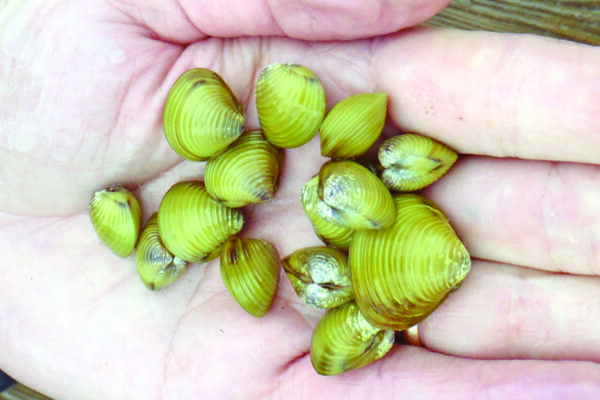
Person holding several Asian Clams

Basket Clam

(Corbicula fluminea)


Species at a Glance 

The Basket Clam, also called the Asiatic Clam, Pygmy Clam, or Gold Clam, is a small, freshwater bivalve that rarely exceeds the size of a nickel. This invasive clam has spread rapidly in lakes, canals, streams, rivers, and reservoirs, threatening ecosystems and lakeside communities throughout North America. 

Species Description 

The shell of the Basket Clam is thick, triangular in shape, and has deep distinctive growth rings. It is typically small, averaging less than 2.5 cm (1 in) and rarely exceeding 6.5 cm (2.5 in). There are two morphs of the Basket Clam in the United States. A lighter morph, with an outside shell typically yellow-green to brown in color, is found in the northeast; and a darker morph exists in the southwestern United States. The inside of the shell is layered with polished, light purple nacre, and finely serrated teeth. Juveniles are free-floating and microscopic, called veligers, and appear under a microscope in a “D” shape less than 1 mm in length. 

Native & Introduced Ranges 

Native to the temperate and tropical regions of Southeast Asia and Africa, it is believed that the Basket Clam was first introduced to the West Coast of the United States in 1924 to be harvested as a food source. By the 1970s, it occupied most of the Mississippi River Basin, the Gulf Coast, and the eastern United States. 

In Pennsylvania, the Basket Clam is widespread and can be found in the Allegheny, Monongahela, Ohio, Susquehanna, Delaware, and Schuylkill rivers and their tributaries as well as many other lakes and streams in Pennsylvania. 

Biology & Spread  

The Basket Clam is a prolific and highly competitive species that is capable of rapid growth and spread. The Basket Clam is hermaphroditic, or capable of self-fertilization. A single clam can release hundreds to thousands of free-floating, microscopic larvae per day. In warmer waters this spawning activity can take place year-round, creating ample opportunities for juveniles to be spread by water currents and human activity as it goes unseen in bait buckets and livewells. 

The Basket Clam can spread by attaching itself to boating, fishing, and scuba diving equipment. It is also sold commercially as bait throughout the United States, and in the aquarium trade.  

Habitat 

The Basket Clam is a hardy and persistent species that prefers a sandy or gravel substrate bottom in streams, rivers, ponds, lakes, and constructed canals. While it is considered a freshwater species, it can withstand slightly brackish waters. Estuarine populations have been reported on both the east and west coasts. It also prefers to colonize in warmer areas near the shore with plenty of sunlight. Although it can withstand freezing conditions, its reproductive ability decreases with exposure to lower temperatures. 

Impacts 

Threat to Biodiversity 

Dense clusters of Basket Clams, often reaching over 6,000 individuals/m2, can alter the natural benthic community of an ecosystem. It is an efficient filter feeder, consuming microscopic plants and animals from the base of the food chain and competing with native mussels, juvenile fish, and other native aquatic organisms for food. Since it can tolerate polluted environments better than many native bivalves, the Basket Clam displaces native species. In many areas, native mussels are in danger of becoming extinct due to the infestations of the Basket Clam. 

Economic Costs 

The Basket Clam causes millions of dollars in damage each year for power plants and industrial water systems. It can clog pipes, irrigation canals, and intake systems, and damage equipment like boat motors, diving gear, and commercial water systems. The Basket Clam also impairs the aesthetic and recreational value of public beaches, lakefront properties, and swimming areas. 

Prevention & Control 

Preventing the introduction and spread of the Basket Clam is the best way to protect natural habitats from harm. 

  • Know how to identify and report the Basket Clam. 
  • Always check for and remove plants, mud, and debris from boats, trailers, clothing, and equipment before entering a water body and before leaving a water body. 
  • Drain all water from bait buckets, bilges, and live wells before transporting to new areas. 
  • Clean all gear and equipment with hot water (140°F or 40°C) or salt water, OR let boats and equipment dry thoroughly for at least five days before entering a new water body. 

References: 

  • Hunter, B. Asian Clam (Corbicula fluminea). Illinois-Indiana Sea Grant. 
  • Massachusetts Department of Conservation and Recreation. Established, Asian clam: An exotic aquatic species. 

Join Our Newsletter

Keep up with the latest news and events by signing up below.


By submitting this form, you are consenting to receive marketing emails from Sea Grant Pennsylvania. You can revoke your consent to receive emails at any time by using the SafeUnsubscribe® link, found at the bottom of every email. Emails are serviced by Constant Contact.

This site is protected by reCAPTCHA and the Google Privacy Policy and Terms of Service apply.