Skip to content
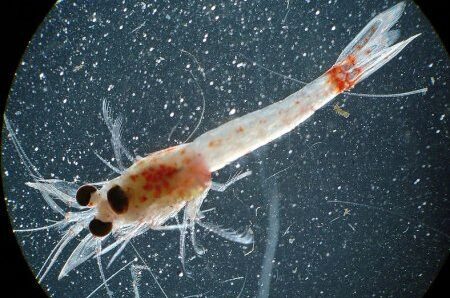
Microscopic view of a bloody red shrimp

Bloody Red Shrimp

(Hemimysis anomala)


Species at a Glance 

The Bloody Red Shrimp is a tiny freshwater crustacean in the order Mysidacea; more commonly referred to as mysids. Mysids are also sometimes called opossum shrimp because females typically carry their eggs in a pouch. 

Species Description 

The Bloody Red Shrimp is small, with males reaching only 8-10 mm and females reaching 11-16 mm. It has large stalked eyes and eight pairs of legs. It is typically red to orange in color due to pigmented cells called chromatophores; however, coloration can be highly variable and change with varying light and temperature conditions. Some individuals lack color completely and are ivory or translucent. 

Without a microscope, the best way to distinguish the Bloody Red Shrimp from other shrimp is by counting legs — it has eight pairs of legs, while most other larger shrimps and decapods have five pairs. With magnification, the Bloody Red Shrimp has a distinctive flat-ended tail with two prominent spikes. 

Native & Introduced Ranges 

Native to the Ponto-Caspian region of Eastern Europe, the Bloody Red Shrimp was first reported in the United States in 2006 in Muskegon Lake, which is connected to Lake Michigan. Since then, its distribution has been tracked throughout the Great Lakes with populations in lakes Michigan, Huron, Ontario, and Erie. In Pennsylvania, populations have been found in Lake Erie, near Presque Isle Bay. 

Biology & Spread 

The Bloody Red Shrimp was most likely introduced into the Great Lakes through ballast water discharges from ocean-going ships. Once this shrimp was introduced to the Great Lakes, subsequent spread to inter-basin areas occurred through bait bucket transfers, hitchhiking in live wells, bilges, boat motors, trailers, hulls, or other equipment used in the water. 

Habitat 

During the day, reddish swarms of the Bloody Red Shrimp can be seen aggregating in the shadowy areas of piers, boats, breakwalls, or rocky crevices. It prefers hard bottom surfaces including rocks and shells and will avoid soft bottoms, vegetation, and sunlight. At night swarms disperse into deeper waters but may be detected by shining a bright light on the water. 

Impacts 

Threat to Biodiversity 

Due to its history of invading canals, streams, lakes, and reservoirs throughout Europe, the Bloody Red Shrimp is considered a high risk for invading inland lakes in the Great Lakes region. Since this omnivore eats a variety of smaller animals including water fleas and algae, it is in direct competition with other aquatic organisms including young fish. However, it may be a potential food source for larger planktivorous fish. There is little or no evidence to support that the Bloody Red Shrimp has significant socio-economic impact or benefit in the Great Lakes. 

Prevention & Control 

Preventing the introduction and spread of the Bloody Red Shrimp is the best way to protect habitats from harm.   

  • Know how to identify and report the Bloody Red Shrimp. 
  • Always check for and remove plants, mud, and debris from boats, trailers, clothing, and equipment before entering a water body and before leaving a water body. 
  • Drain all water from bait buckets, bilges, and livewells before transporting to new areas. 
  • Clean all gear and equipment with hot water (140°F or 40°C) or salt water, OR let boats and equipment dry thoroughly for at least five days before entering a new water body. 

Join Our Newsletter

Keep up with the latest news and events by signing up below.


By submitting this form, you are consenting to receive marketing emails from Sea Grant Pennsylvania. You can revoke your consent to receive emails at any time by using the SafeUnsubscribe® link, found at the bottom of every email. Emails are serviced by Constant Contact.

This site is protected by reCAPTCHA and the Google Privacy Policy and Terms of Service apply.