
Round Goby
(Neogobius melanostomus)
Species at a Glance
The Round Goby is a small, but aggressive bottom-dwelling fish that grows rapidly and reproduces several times in one spawning season. It is a threat to aquatic ecosystems as it causes declines in native species of fish and poses a threat to health as it can harbor contaminants such as heavy metals, PCBs, harmful bacteria, and toxins in its fatty tissues.
Species Description
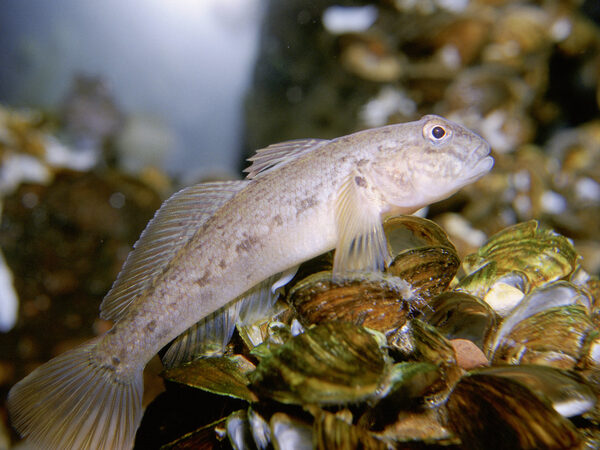
The body of the Round Goby is soft, with a large round head, thick lips, and distinctive frog-like raised eyes. Fully grown, it reaches 10-25 cm (4-10 in) in length. Females and immature males are a solid slate gray mottled with black and brown spots. Spawning males turn almost solid black. Two distinguishing characteristics of the Round Goby are a single, scallop-shaped pelvic fin and a distinctive black spot on the dorsal fin.
The Round Goby closely resembles the native Mottled Sculpin, but the two species can be easily separated by looking at the pelvic fins. The Mottled Sculpin has two separated pelvic fins compared to the single, fused pelvic fin found on the Round Goby. The Sculpin also lacks the large black spot found on the dorsal fin of the Round Goby.
Native & Introduced Ranges
The Round Goby is native to Eurasia in the Black, Caspian, and Azov seas and tributaries. It was first discovered in the St. Clair River in 1990, presumably released during ballast water exchanges of transoceanic ships. It has since spread to all the Great Lakes and is now working its way inland through rivers and canal systems. In Pennsylvania, the Round Goby is present in northwestern Pennsylvania in Lake Erie and its lower tributaries, the Fairview Gravel Pits Pond, Lake LeBeouf, and French Creek in Erie and Crawford Counties.
Biology & Spread
Young Round Gobies often resemble small bait fish and can be spread by boaters and fishermen who carry them from one body of water to another in bait buckets, bilge water, and on plant debris. Anglers will often use the Round Goby as bait; however, it is illegal to possess and transport this species in Pennsylvania and other states. The Round Goby quickly establishes and spawns from April to September, with females visiting multiple nests to spawn with several males. Male Round Gobies ferociously defend their nests, resulting in many healthy offspring in a very short time.
Habitat
The Round Goby is most frequently found in shallow waters with rocky and sandy bottoms, or under large woody debris within streams, where it can perch on the top of rocks and hide in crevices. It can occupy a variety of depths and tolerate a wide range of temperatures, water quality, and oxygen concentrations. It can also thrive in brackish water and degraded ecosystems.
Impacts
Threat to Biodiversity
The Round Goby routinely thrives at the expense of native fish populations by out-competing them for food and breeding habitat. It feeds on aquatic macroinvertebrates, small native freshwater mussels, and the eggs and young of native species. The Round Goby poses a particular threat to Smallmouth Bass, as it often feeds on their eggs and fry. It has a competitive advantage because it can feed in complete darkness and aggressively defends prime spawning areas. While generally poor swimmers, the Round Goby uses its pelvic fin as a suction cup to keep it anchored to rocks and substrates in rapid currents.
Economic Costs
The Round Goby feeds on the eggs of many important sport fish, reducing their ability to maintain population size. In addition, the Round Goby can dominate popular fishing areas and is well known for stealing bait.
Threat to Human Health
In addition to fish eggs and other aquatic organisms, the Round Goby feeds heavily on Zebra and Quagga Mussels. Because invasive mussels are filter feeders, they can accumulate contaminants such as heavy metals, PCBs, harmful bacteria, and toxins in their fatty tissues. Since many sport fish, including Smallmouth Bass, Yellow Perch, and Walleye, are found to prey on the Round Goby, the direct transfer and bioaccumulation of the contaminants moves up the food chain, leading to more restrictive fish consumption advisories. They have also been implicated as vectors of disease such as Type E botulism in the Great Lakes that has caused widespread fish and bird kills.
Prevention & Control
Preventing the spread of the Round Goby to new areas is the best way to protect from further ecological and economic damage. Anglers are often the first to discover new infestations because the Round Goby is commonly caught by hook and line and is captured while trapping for minnows and other baitfish.
Know how to identify the Round Goby. Always check for and remove any plants, mud, and debris from boats, trailers, clothing, and equipment before leaving a water body. According to Pennsylvania Fish and Boat Commission regulations (58 Pa. Code Chapter 71):
- Boaters must drain all water from their boat and remove drain/bilge plugs before leaving a water body.
- Unused live bait should be disposed of in the trash; it is unlawful in Pennsylvania to release any unused live bait into Commonwealth waters. Round Goby should never be used as bait.
- Clean and dry all equipment after use. It is unlawful in Pennsylvania to transport plants, mud, or debris on boats and trailers.
- It is illegal to possess, transport, sell, or introduce Round Goby, living or dead, in Pennsylvania. The Pennsylvania Fish and Boat Commission Law Enforcement staff regularly check bait buckets for Round Goby, and possession of the species can lead to legal penalties.
References:
- Crosier, D. and Malloy, D. 2005. Round Goby. United States Federal Aquatic Nuisance Species Task Force.Great Lakes Science Center. 2000. Fact Sheet: Round Goby:
- An exotic fish in the Great Lakes.United States Fish and Wildlife Service. 2011. Round Goby Q&A.Pennsylvania Fish and Boat Commission 2023. 2023 Pennsylvania Fishing Summary.